

By Craig Norman
Dr. Bobby “Chip” Wood’s optometry practice sits in South Texas, where a large share of his patients are Hispanic families and astigmatism appears in the exam chair far more often than his early training suggested. “I didn’t fully appreciate how much astigmatism would shape my day-to-day practice until I started seeing the numbers reflected in my own patient base,” Dr. Wood says. “So many of my myopia management candidates aren’t simply nearsighted. They have meaningful astigmatism on top of it, and for years I didn’t have a daily disposable toric option to offer them.”
For Dr. Wood, the gap is a personal one. Parents in his community already worry about myopia, and astigmatism, with its reputation for being harder to fit and explain, often adds another layer of anxiety to the exam room conversation. Being able to add a one-day disposable toric soft lens to his practice’s product offerings for this patient population, he says, is something he has been keenly interested in for some time.
Why Is Astigmatism Correction Important for Children with Myopia?
Uncorrected astigmatism is not a minor refractive footnote, as it measurably affects how patients see and function day to day. Population-based research finds that over 40% of eyes carry at least 0.75 D of astigmatism,¹ and even modest, uncorrected amounts have been linked to eyestrain, headaches, slower reading speed, and more errors on visual tasks.2-4 Toric correction has been shown to significantly improve visual acuity and reduce these symptoms compared with spherical lenses alone.2-4
Why Is Astigmatism More Common in Hispanic Children?
This burden is not distributed evenly across ethnic groups, and Dr. Wood’s South Texas patient base reflects that disparity directly. Data from the Collaborative Longitudinal Evaluation of Ethnicity and Refractive Error (CLEERE) study found that 36.9% of Hispanic children presented with astigmatism (≥1.00 D), the highest prevalence among the groups studied, compared with 33.6% of Asian children and 26.4% of Caucasian children.5 The Multi-Ethnic Pediatric Eye Disease Study (MEPEDS) similarly found clinically significant astigmatism (≥1.50 D) in 16.8% of Hispanic children, compared with 12.7% of African American children and just 6.33% of non-Hispanic white children; Hispanic children showed more than double the rate of high astigmatism (≥3.00 D) seen in the other groups.6,7 A separate study of Head Start preschoolers, conducted as part of the Vision in Preschoolers (VIP) research program, found astigmatism in 22.2% of Hispanic children versus 11.3% of non-Hispanic white children, with the authors noting the pattern held consistent across multiple population-based studies.8
The Challenge of Managing Myopia and Astigmatism Together
In Dr. Wood’s practice, parents are often more anxious about astigmatism than about myopia itself, largely due to its reputation for clinical complexity. His staff works to educate every family on the full range of options (glasses, contact lenses, and drops), tailoring the discussion to each patient’s needs. That residual blur, Dr. Wood notes, does more than affect vision; it can undermine overall satisfaction and compliance with treatment at exactly the age when consistent wear matters most.
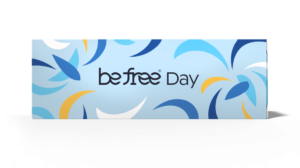
Introducing Be Free® Day Toric Daily Disposable Contact Lenses
The Be Free® Day toric daily disposable soft contact lens (in toufilcon B) is designed to close that gap. Dr. Wood says he is particularly impressed that the Brien Holden Vision Institute (BHVI) played a significant role in developing the lens’s design, an institute whose name, he notes, carries considerable weight and respect within the global myopia management community.
The lens is manufactured in toufilcon B, a silicone hydrogel material with an oxygen transmissibility of 91 Dk (114 Dk/t), a level of oxygen exchange Dr. Wood considers essential for protecting young corneas against hypoxia over years of daily wear. The material’s moderate modulus (0.65 MPa) improves lens stability, which Dr. Wood says makes handling and insertion easier for younger patients and reduces the chair time and staff training required to fit them. Its advanced biomimetic surface material may enhance lens wettability, resist deposits, and help patients stay comfortable throughout the day while addressing the dryness that can accompany extended screen time.
Expanding Toric Contact Lens Options for Myopia Management Practices
For Dr. Wood, the Be Free® Day toric lens addresses a need that is neither rare nor peripheral in his South Texas practice. “This product would help address the specific needs of my practice, particularly for managing myopia and astigmatism in young patients,” he says. He is optimistic about what the lens’s oxygen performance, rotational stability, and visual clarity could mean for both the safety and comfort of his patients, and for his practice’s ability to keep pace with the modern myopia epidemic.

References
1. Luensmann D, et al. Magnitude of astigmatism—a comparison between eyes. Cont Lens Anterior Eye. 2022;45(5):101510.
2. Berntsen DA, et al. A randomized trial to evaluate the effect of toric versus spherical contact lenses on vision and eyestrain. Eye Contact Lens. 2019;45(1):28-33.
3. Chao C, et al. Soft toric contact lens wear improves digital performance and vision: a randomised clinical trial. Ophthalmic Physiol Opt. 2023;43(1):25-34.
4. Wolffsohn JS, et al. Effect of uncorrected astigmatism on vision. J Cataract Refract Surg. 2011;37(3):454-460.
5. Kleinstein RN, et al. Refractive error and ethnicity in children (CLEERE Study). Arch Ophthalmol. 2003;121(8):1141-1147.
6. Cotter SA, Varma R, et al; Multi-Ethnic Pediatric Eye Disease Study Group. Prevalence of astigmatism in 6- to 72-month-old African American and Hispanic children: the Multi-Ethnic Pediatric Eye Disease Study (MEPEDS). Ophthalmology. 2011;118(2):284-293.
7. Wen G, Tarczy-Hornoch K, McKean-Cowdin R, et al; Multi-Ethnic Pediatric Eye Disease Study Group. Prevalence of myopia, hyperopia, and astigmatism in non-Hispanic white and Asian children: Multi-Ethnic Pediatric Eye Disease Study. Ophthalmology. 2013;120(10):2109-2116.
8. Huang J, et al. Risk factors for astigmatism in the Vision in Preschoolers (VIP) Study. Optom Vis Sci. 2014;91(5):514-521.
9. US Food and Drug Administration. 510(k) Premarket Notification K243868: Be Free® Day (Toufilcon B) toric Daily Disposable Soft Contact Lenses. Accessed July 8, 2026. https://www.accessdata.fda.gov/cdrh_docs/pdf26/K261299.pdf
The Be Free® Day lens (utilizing the SAM-06 optical profile in toufilcon B material) has been cleared by the FDA. It has not been approved for use in slowing myopia progression, and the safety and effectiveness of Be Free® Day for slowing myopia progression has not been established with the FDA.
Financial Disclosure: Dr. Bobby “Chip” Wood has received compensation from Euclid Vision Corporation for his professional consulting related to Be Free® Day contact lenses.
This article was developed using several editorial tools, including AI-assisted technologies, as part of the content creation process. Human editors reviewed the content for accuracy, quality, and relevance prior to publication.